Great in Practice, Lost in Games? How to Stop Overthinking in Hockey
In practice the puck is on a string. In the game the same player looks a step behind: an extra touch, eyes down, the safe play every time. Coaches call it gripping the stick too tight. Psychologists call it choking under pressure, and they have spent forty years working out why a skill that runs by itself on Tuesday falls apart on Saturday. This guide covers what overthinking is, why practices and games are different jobs for your attention, what it looks like on film, seven ways to fix it, and what parents can do from the car. Every outside fact links to the study, interview or coaching article it came from.
How to stop overthinking in hockey: the short answer
To stop overthinking in hockey games, do these seven things. Trying harder is not one of them:
- One cue per shift. Take one job over the boards, about the play and not about your body.
- Look before the puck comes. Scan early, so the decision is made before the pressure arrives.
- A ten-second reset. Breathe out, park the last shift, name the next job. The same three steps every time.
- Pressure in practice. Keep score, shrink the ice, turn on a camera. Rehearsed pressure stops feeling like pressure.
- Think on film, not on the ice. The ice is for playing. The analysis goes on the video, where there is time for it.
- A plan for the first mistake. Decide before the game what you will do after a bad shift, because one is coming.
- Score what you control. Grade the game on three jobs you can do every shift, not on points.
What overthinking is, in plain terms
Overthinking is not thinking too hard about hockey. It is attention going to the wrong place at the wrong moment: onto your own hands, your feet and your last mistake, in the middle of a play that needs your eyes on the ice. Players call it freezing up or playing tight. Parents call it playing scared.
Researchers have studied it since the 1980s under a blunter name. Roy Baumeister defined choking under pressure as “performance decrements under circumstances that increase the importance of good or improved performance”, and proposed a cause: pressure makes a performer pay conscious attention to how the skill is being done, and that attention “disrupts the automatic or overlearned nature of the execution.” Sian Beilock and Thomas Carr tested the idea on golfers in 2001 and reported that their results supported the popular belief that “attending to proceduralized skills hurts performance”.
Proceduralized is the important word. A wrist shot you have taken ten thousand times runs on its own. Start supervising it halfway through the release and you are in its way.
Rob Gray, who studies attention in athletes, describes the moment it starts: “We think when you're under pressure, that your attention goes inward naturally. Suddenly it means so much, you want to make sure everything's working properly.” Peter Haberl, then a sport psychologist for the United States Olympic Committee, gave USA Hockey the version players can use: “We want to make a distinction between attention and thinking. They're both valuable, but thinking almost always gets in the way of performance.”
Hockey has its own phrase for the result. In December 2023 Alex Ovechkin was in the middle of a 13-game goal drought, the longest of his career to that point, and told NHL.com: “sometimes it's just a period of maybe you hold the stick too tight because you didn't score or something.” In Hockey Tough, the sport psychologist Saul Miller describes a talented young centre who, “like many hockey players, she would think too much and about too many things when she was under pressure.” The cost was physical. It made her tense, “slowed her reactions, and reduced her touch.”
Players have a word for the opposite, too. Ville Husso, a goalie with the Anaheim Ducks, told NHL.com for a November 2026 article: “You play the best when you are in that flow mode and let the game come to you instead of thinking the game.” Lukas Dostal, his Ducks teammate, said that in a state of flow “you don't really think. You just keep playing.” Nobody can order flow up. Overthinking is what blocks it, and that part can be worked on.
Two things overthinking is not. It is not a lack of effort: as the goalies in this guide explain, more effort usually makes it worse. And it is not always the real problem. Sometimes the skill is simply not ready for game speed, and no mental technique fixes that. Sorting out which one you have comes first.
Why you play better in practice than in games
Practice gives you time, a known pattern and nothing to lose. A game takes all three away. Under pressure, attention turns inward, onto how you are doing the skill, and that gets in the way of skills that normally run on their own. NHL players average 1.29 seconds a possession, so there is no time to sort it out with the puck on your stick.
A practice and a game look like the same sport. For your attention they are different jobs, and each of the three differences pushes a player toward thinking.
No time. The numbers here are smaller than most players guess.
Researchers at the University of Waterloo used the NHL's puck and player tracking data from the 2023-24 season, 1,194 games, to time every individual possession at five-on-five. Their finding: “On average, players hold the puck for 1.29 seconds.” In the offensive zone the average falls to 1.05 seconds. A skater gets about 33 or 34 possessions for every 20 minutes of ice time and spends, in total, about 3.3% to 4.2% of that time with the puck.
Source: Iaboni et al., Linköping Hockey Analytics Conference, 2025A second and a quarter is not enough time to see a pass arrive, weigh three options and pick one. In a drill it does not need to be, because you already know where the puck goes next. In a game the choosing has to be finished before the puck gets to you, which is why the fixes below start with where you look.
No script. Most drills have one right answer and everyone knows it in advance. Games do not. Bob Mancini, USA Hockey's assistant executive director of hockey development, asks coaches a question every practice player should hear: “Do your players know what to do when hockey breaks out?” A player who has only rehearsed answers looks sharp until the question changes.
Something to lose. Parents in the stands, a scout at the glass, a coach who shortens the bench. Pressure does two things to attention. It turns it inward, as Baumeister and Gray describe. And it turns it toward whatever feels dangerous: attentional control theory, a leading account of how anxiety affects attention, holds that anxiety weakens the goal-directed system a player uses to stay on task and “increases attention to threat-related stimuli”. On the ice the threat is the forechecker, the mistake you just made, or the bench.
Nobody grows out of it. A study of NHL shootouts from the 2006 to 2011 seasons compared home and visiting shooters and found a home advantage when a team had to score to stay alive, and a home disadvantage “in win-imminent situations when a team was shooting to win”. The best players in the world, in their own building, with the game on their stick.
First, rule out a skill gap
Before you work on your head, check your hands. The research on attention has a second half that most advice leaves out.
In 2002 Beilock's group had soccer players dribble through a slalom course two ways: with a second task pulling their attention away, and while made to pay attention to the dribbling itself. Experienced players on their strong foot were better with their attention pulled away. On their weak foot the same players did better when they concentrated on the skill, and beginners did better concentrating whichever foot they used. The authors' summary: “Whereas novices and the less-proficient performances of experts benefit from online attentional monitoring of step-by-step performance, high-level skill execution is harmed.”
So thinking about a skill is right while the skill is being built, and harmful once you own it. That gives you a fair test.
Most players are a mix: a backhand that is not ready, and a forehand they have stopped trusting. Be honest about which is which. Reading the play is a skill of its own, and how to improve your hockey IQ covers the habits behind it.
The film check: five signs of an overthinking player
Overthinking is hard to see from the inside. On video it is easy, because a player who is supervising every move does the same five things. Watch three shifts with the sound off and look for them.
| The sign | What the film shows | What is going on | Start with |
|---|---|---|---|
| Puck-locked eyes | The head never turns before a pass arrives. The eyes drop to the puck and stay there. | Attention has narrowed to the one thing that feels dangerous. | Fix 2: look early |
| The extra touch | The puck sits on the stick for two or three seconds with a play open. Stickhandling on the spot. | The decision is being made after the puck arrives, not before. | Fixes 1 and 2 |
| Feet that stop | Gliding, or standing still, the moment the puck comes. | The body is waiting while the head works. | Fix 1: one cue |
| The safe play | A rim, a chip off the glass or a pass straight back, with nobody near. | Avoiding the mistake has become the goal. | Fixes 6 and 7 |
| The quiet shift | The shift after a turnover is shorter, and played further from the puck. | The last play is still running. | Fix 3: the reset |
The first sign is the one to count. A study of 22 games in Sweden's top men's and women's leagues found that players who scanned before receiving a pass were more likely to succeed with their next action. A player who has stopped looking has stopped collecting what the next play needs, and then has to think through it with the puck already on the stick. Casey DeSmith, an NHL goalie, describes the same narrowing from the crease: “We are staring down the puck, and I'm not taking in the full ice visually, so my reads aren't as good”.
The second sign has a number to hold it against. NHL players average 1.29 seconds a possession. If your film shows three, the game is not too fast for you. You are giving the time away.
One caution. The same signs show up in a tired player, a player in a new position, and a player whose skill is not ready, which is what the test above is for. Film tells you what happened. It takes a few games, and often a second pair of eyes, to know why. If getting usable footage is the obstacle, start with how to film a hockey game.
1. Take one cue over the boards
The first fix is about where the thinking happens. Performance coach John Haime borrowed an idea from two golf coaches and moved it to the rink: the bench is the Think Box and the ice is the Play Box. On the bench you can review the last shift and listen to your coach. Then, Haime writes, you “distill all of this down to one key thought”, and when you go over the boards the thinking part is over.
One thought, because one is what fits. And the kind of thought matters. Three rules, each with research behind it.
Make it about the play, not your body. Gabriele Wulf and colleagues tested what they call the constrained-action hypothesis: that a performer who focuses on their own movements “may actually constrain or interfere with automatic control processes”, while a focus on the effect of the movement lets the body organize itself. In their balance experiment the group that focused on the effect made smaller errors and needed less attention to do it. “Knees bent, elbow up” is a practice thought. “Far pad” is a game thought. Mike Condon, who played 129 NHL games in goal and now works with athletes as a mental performance counselor, put the cost in a goalie's terms for NHL.com. If you are telling yourself “Keep your glove up” on a two-on-one, he asked, “how much of your energy is focusing on where your glove is versus where his weight is on his blades or where his eyes are looking”?
Say what to do, never what to avoid. In a penalty-kick experiment, soccer players were told to keep the ball away from the goalkeeper. When they put it near the keeper anyway, which researchers call an ironic effect, those kicks came with a shorter final look at the open part of the net. “Don't turn it over” points you at the turnover. “Hard off the wall” points you at the play.
Rehearse it. A meta-analysis of 32 studies found that self-talk improves sport performance by a moderate amount, and that “interventions including self-talk training were more effective than those not including self-talk training”. A cue you invent on the bench in the third period is one more new thought. A cue you have used in practice all week is a habit. Haberl gave USA Hockey two examples of what a cue is for: “I can focus my attention on seeing the puck. Or focus on getting a puck deep into the zone.”
Cues that work are short, about the play, and stated as something to do:
- Forwards: “Stop on pucks.” “Middle lane.” “Far pad.”
- Defensemen: “Eyes up early.” “Stick on puck.” “First pass hard.”
- Goalies: “Next shot.”
One per game is enough. A player who changes cue every shift is thinking again.
2. Look early, then lock on
The most useful thing an overthinking player can do happens before the puck arrives. A decision made with the puck on your stick is made under pressure and against the clock. A decision made on the way to the puck is free.
That is how skilled players use their eyes. Researchers at the University of Calgary put eye trackers on players in a live defensive-zone task. On successful plays the elite group fixed on the tactical spots more quickly early in the play, and both groups finished with one long look at a single target before they acted. Quick looks first, then a lock. In the Swedish study, the players who scanned before the pass arrived were the ones more likely to make the next play.
The lock matters as much as the look. The same lab tracked the eyes of elite goaltenders facing wrist shots. On saves, the final steady look at the puck began earlier and lasted longer than on goals: 952 milliseconds against 826. Researchers call that last look the quiet eye, and in a study of elite biathletes shooting under pressure, keeping attention on the target “appeared to insulate the athletes from choking”.
To train it:
There is more on building this habit, and on counting it, in our hockey IQ guide.
3. Build a ten-second reset
You cannot stop a thought by telling yourself to stop. You can give your attention somewhere else to go, and you can practice sending it there. That is all a reset is.
Hockey's version has a name. Miller calls it parking: “if you have had a bad shift, let it go and focus on being effective the next time out”. Paul Kariya, asked by Miller before he retired, said a sport psychologist with the Canadian national program introduced the idea and that he still used it: “If someone chops or slashes me, I park it and refocus.” Cassie Campbell, who twice captained Canada to Olympic gold, called the ability to park it the most important mental quality a player can acquire.
Routines like this are among the better-tested tools in sport psychology. A University of Vienna team pooled results from 15 sports and 800 athletes and found that athletes performed better with a pre-performance routine than without one, in the laboratory and in competition, with pressure and without it. A 2026 meta-analysis of 21 studies on choking concluded that the fixes researchers have tested, routines, self-talk and gaze training among them, “are generally effective in reducing the decline in sport-specific performance under pressure”.
The honest limit: the Vienna study's senior author says a routine helps in any task “which allows a few seconds of preparation time”, and the 2026 review found smaller and less reliable effects in open play than in set skills such as a free throw. Hockey hands you those few seconds all game. The bench. The faceoff. The whistle after an icing. That is where the reset goes.
To take all of this to the rink, print the One-Cue Card, a free one-page hockey game-day sheet (PDF): your cue, three if-then plans, the reset and the film questions.
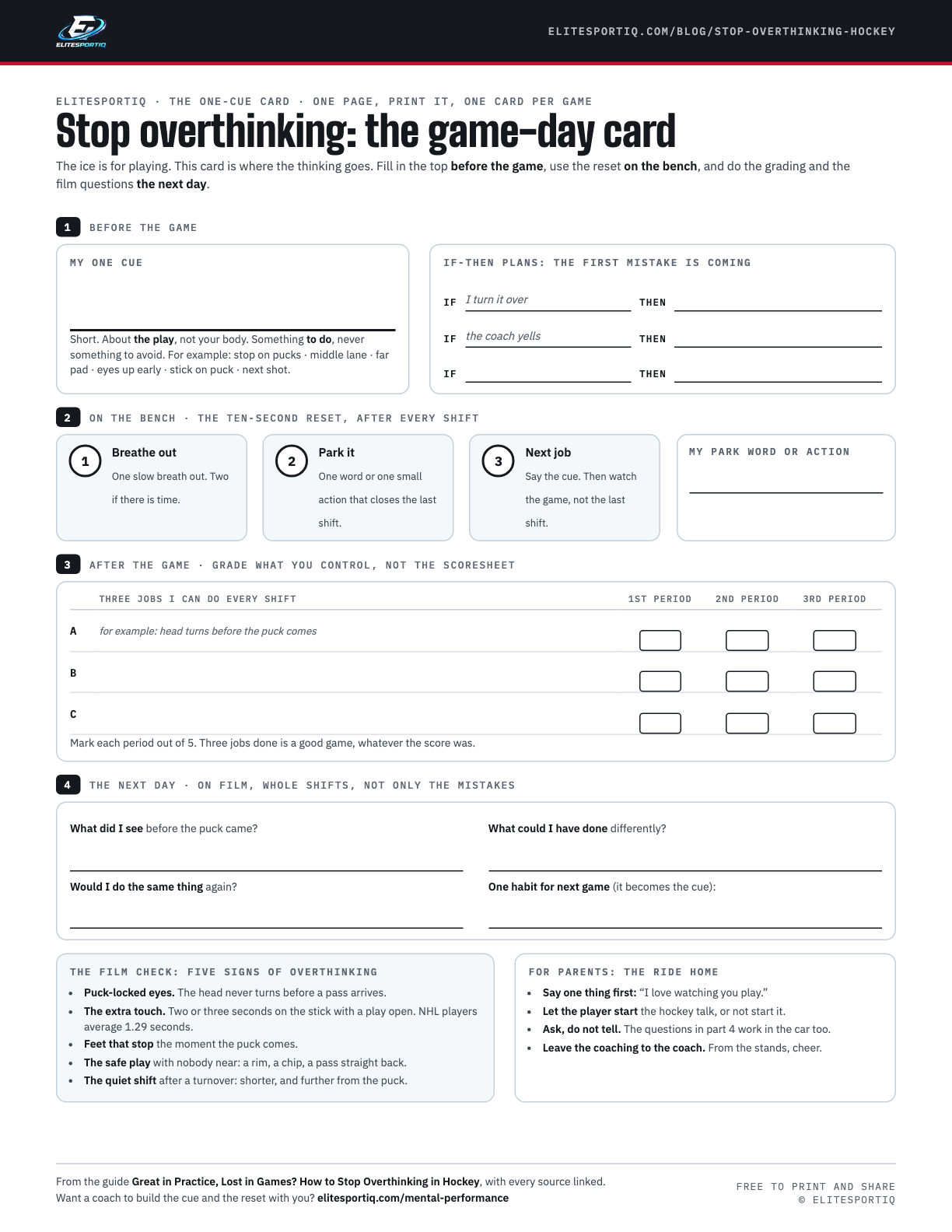
Ten seconds. Do it after good shifts as well as bad ones, so it is a habit before you need it. Ville Peltonen, a four-time Olympian who played 23 professional seasons, told Miller that mental tools have to be practiced like anything else: “I believe it is a skill just like skating or shooting.” For a longer routine to use before the game, see our pre-game visualization routine.
4. Put pressure into practice
If a skill holds up in drills and falls apart in games, practice is too comfortable. The answer is not more reps. It is reps with something riding on them.
Two experiments make the case. In Amsterdam, 17 expert basketball players practiced free throws for five weeks, with or without anxiety deliberately added. Tested under pressure afterward, only the group that had trained with anxiety held its level. And in Beilock and Carr's putting study, one group of learners practiced with a video camera pointed at them, having been told that golf coaches would review the tapes. Under pressure later, the groups that had practiced without the camera got worse. For the camera group, the paper reports, “self-consciousness training eliminated choking completely”, and those putters actually improved.
USA Hockey's coaches make the same argument in hockey terms. Mancini wants practices where sticks get knocked out of hands and the teams are lopsided, because “It's failure from practice that will make your team better.” Kenny Rausch, then USA Hockey's youth hockey manager, on small-area games: “If a player can make quick decisions and perform his or her task in a confined area, that player will be able to do it more easily when time and space is available.”
What a player can do without waiting for the coach:
- Keep score. Any drill with a count and a consequence. Loser picks up the pucks.
- Shrink the ice. Three-on-three cross-ice, a battle in the corner, shinny at the outdoor rink. Less room means more pressure and more decisions per minute.
- Turn on a camera. Film your own reps knowing someone will watch them. It is the cheapest pressure there is, and you get footage out of it.
- Go first. Volunteer for the demonstration, the shootout, the hard matchup. Being watched is a skill, and it takes reps like any other.
It should feel worse than a normal practice. That is the point: pressure you have rehearsed is not news on Saturday.
5. Move the thinking to the film room
None of this means a player should stop analyzing their game. It means the analysis has an address, and the address is not the ice. On the ice you have 1.29 seconds. On video you have a pause button, as long as you like, and no forechecker.
Players with nowhere to put their thinking carry it back onto the ice and into the middle of shifts, because the questions are real: why did I lose that battle, where should I have been. Give those questions an appointment. Then, during the game, anything the bench cannot settle in a few seconds gets one honest answer: “I will look at it tomorrow.”
A review that settles a player, and does not wind them up, has rules:
This is the part we do for a living. In a video analysis session a coach goes through your game with you, live, for 60 minutes. Mental performance coaching works on the routines in this guide the same way, one-on-one. The principle holds if you do it yourself: watch film with a method, and the ice gets quieter.
6. Plan for the first mistake
Every overthinking spiral starts with one play. A turnover, a missed net, a look from the coach. The player who handles it is not the one who avoids the mistake. It is the one who decided beforehand what happens next. If you play scared of making mistakes, this is the fix to start with.
Haberl teaches Olympic athletes a method for exactly this, and says players at 14U and 16U can use it. Instead of picturing the perfect game, “what you actually want to do is visualize the obstacles to doing well”, and then attach a plan to each one: “If X arrives in my mind, I will do action ABC.”
Written for hockey, an if-then plan is short:
- If I turn it over, then I stop, get back above the puck, and do my reset on the bench.
- If the coach yells, then I nod, breathe out and say my cue.
- If I miss an open net, then I want the next one. Ovechkin put 46 shots on goal during his drought.
Write three before the game. The first mistake is coming, in every game, for every player. Planning for it takes away the surprise, and the surprise is most of what hurts. Evaluators notice the response more than the error: the shift after a mistake is one of the things scouts grade. For the longer job of getting over a rough night, see how to bounce back after a bad game.
7. Score the game on what you control
The last fix is about what you ask of yourself. A player who needs a goal tonight has taken on a job nobody can do on purpose. Devan Dubnyk, who played 542 NHL games in goal, on why pressing fails: “You can't go out and pitch a 50-save shutout if you only get 10 shots. You have to let everything come to you”. Jake Oettinger of the Dallas Stars described what a hard stretch had done to him in 2024: “I was just so focused on trying to do well that I stopped just having fun and playing the game.” What turned his season, NHL.com reported, was going back to a next-shot focus.
Results are the worst thing to aim at because you cannot do them. You can only do the things that make them more likely. So score those. Pick three jobs you can complete on every shift whatever the scoreboard says, and grade yourself on them after the game:
- Forwards: stops on pucks, the first three strides of the backcheck, shots attempted from the slot.
- Defensemen: shoulder checks before retrievals, first passes on the tape, sticks in lanes.
- Goalies: set before the release, eyes on the puck off the stick, rebounds to the corners.
Mannix describes a friend who does this with a young child. The player sets a goal before the game and they go over it on the way home, which “allows the child, the player, to set their own goal”. Three jobs done is a good game, whatever the scoresheet says. Points tend to follow players who do their jobs, and to avoid players who chase them.
The One-Cue Card (PDF) has the grid for it: three jobs, three periods.
Nervous before a game? Give the nerves a job
Pre-game nerves are the body getting ready, and trying to calm down is not the best use of them. In studies by a Harvard researcher, people who relabeled the feeling as excitement performed better than people who tried to calm down. So rename the feeling, keep your warm-up the same every game, and take one simple cue into the first shift.
The research is worth a closer look, because it runs against instinct. Alison Wood Brooks of Harvard Business School found that “an overwhelming majority of people believe trying to calm down is the best way to cope with pre-performance anxiety.” Then she tested the alternative. Across studies of karaoke singing, public speaking and math, people who relabeled the feeling as excitement, some by doing no more than saying “I am excited” out loud, did better than people who tried to calm down. Sport scientists tested a close cousin of the idea on a motor skill: 50 people had one attempt at a task under pressure, and the group told to treat that keyed-up feeling as a tool that helps performance outperformed the group given no such instruction.
So do not fight the nerves. The slow breath from fix 3 still belongs on the bench. What changes is what you call the feeling:
- Rename the feeling. Say “I am excited”, the words the Harvard studies used, not “calm down”.
- Keep the warm-up the same. Same order, every game, so the start of the game feels familiar. The routines that research has tested are shorter, the few seconds before a play: those are in fix 3.
- Take your cue into the first shift. One simple job, done early, and the game has started.
USA Hockey gives coaches the same idea for pressure during a game: when a bad call or a cheap shot brings pressure and negative emotions, encourage players to experience those emotions “as a fun part of the challenge and thrill of competition”. Nerves that follow a player away from the rink are a different thing, covered at the end of this guide.
Goalies: good in practice, fighting the puck in games
A goalie who is sharp in practice and fighting the puck in games is often trying too hard. Tension stiffens the limbs, lets rebounds get away and locks the eyes on the puck, so the reads get worse. The fix is a next-shot cue and a reset after every whistle, not more effort.
All of this applies to goalies twice over, because the position is almost purely reactive. DeSmith again: “Goaltending is not an effort-based endeavor”, and “I would say tension is the enemy.” He describes what a goalie's version of squeezing the stick does: stiff limbs, hands that are not loose, rebounds that get away, and eyes that bear down on the puck and miss the rest of the ice. Dubnyk adds the tactical cost. A goalie who is pressing plays further out and starts to chase, and “once you cross that line and start to chase the play, it's over.”
NHL goalies said it again in a November 2026 NHL.com piece on Calgary's Devin Cooley, whose post-game interviews about a goalie's mind the site calls “can't miss”. It quotes Cooley saying that “my conscious brain is really bad at playing goalie, so I have to let my unconscious brain do the work, because it reacts a lot quicker.” Husso agreed: “when you think too much in the net, I don't think it's a good thing for goalies.” Condon explained why. Take a movement you already know, try to control it with the conscious mind, and “you're going to have clunky movements.”
The goalie's cue is the oldest one in the crease, the focus NHL.com's 2024 piece on trying too hard calls “next shot, next save”. The reset goes after every whistle, and after every goal against in particular. And the quiet-eye result above is a goalie result: on saves, the last steady look at the puck started earlier and lasted longer. Tracking is the skill. Trying harder is not. The other half of the position, reading the play before the shot, is in reading shooters.
By age: when thinking about the skill is the right thing
Younger and newer players should be thinking about their skills. That is the other half of the soccer study: beginners did better when they concentrated on the skill, and so did experienced players on their weak foot. A nine-year-old concentrating on crossovers is not overthinking. That is learning.
- 10 and under. No mental techniques needed. The job is puck touches and games. Guy Gosselin of USA Hockey's American Development Model: “Everything at the youth hockey level is about repetition”, and small-area games are where players learn “to think ahead”. For parents at this age, the car ride matters more than any routine.
- 11 to 14. Often when the gap first shows, because games start to count: tryouts, tiers and ice time. One cue and a simple reset are enough. Our own mental performance coaching starts at 12.
- 15 and up. The full set: if-then plans, grading on what you control, and a regular film review. This is also when the people in the stands start writing things down.
For parents: the car ride home
A parent cannot fix overthinking from the stands, but can make it worse from the driver's seat. Mannix: “I think parents call that the worst 30 minutes in sports, the car ride home.”
The mechanism is simple. A player who knows the game will be reviewed in the car plays the game for the review. Every shift gets a second audience. Mannix names where the pressure starts: families want to know the time and money are worth it, and “Wins and losses become the very easy and simple indicator. That translates into pressure coaches feel and kids feel.”
What USA Hockey's people suggest in its place:
- Say one thing first. Mancini: “The most important thing is that we tell our kids how much we enjoy watching them play”. Mannix's own line is “I love watching you play.”
- Let the player start the hockey talk. Mancini again: “We should remember it's not about us, it's about the players.” Some kids want to go through the game. Many do not, win or lose.
- If you talk, ask. The three questions from the film room. Tone decides it. Mannix loved going through games with her own father on the way home, because he asked and did not tell: “If it's coming from a tone of criticism it's going to be a different conversation.”
- Leave the coaching to the coach. A player listening for a voice from the glass has one more thing to think about.
- Watch the film check, not the scoresheet. A game with the head up and the feet moving is progress, even at minus two.
When it is more than overthinking
Nerves before a game are normal, as the section on nerves explains. The tools in this guide are for performance: a player who is fine away from the rink and tight in games.
Some things are outside that, and a blog post or a performance coach is not the right help for them. Worry that follows a player to school and to bed. Panic. A player who starts dreading or avoiding hockey altogether. Changes in sleep, appetite or mood that last. For any of those, talk to your family doctor or a licensed mental health professional. Mental performance coaching, ours included, works on performance. It is not therapy and it does not replace it.
Common questions
Why am I good in practice but bad in games?
Practice gives you time, a known pattern and nothing to lose. A game takes all three away, and pressure turns attention inward, onto your own movements and mistakes, which disrupts skills that normally run on their own. NHL players average 1.29 seconds per puck possession, so the decision has to be made before the puck arrives.
Is it a skill problem or a mental problem?
Test it at game speed. If you cannot do the skill in a small-area game or a battle drill with a checker on you, it is a skill gap and it needs reps, not a mental fix. If the skill holds up there and disappears when the game counts, the skill is fine and your attention is the problem.
How do I stop overthinking in hockey?
Do your thinking on the bench and on video, not during the shift. Start with three habits: take one short cue over the boards, about the play and not about your body; look before the puck comes, so the decision is already made; and use the same ten-second reset after every shift. The guide above has seven fixes in all.
Why do I freeze up in hockey games?
Freezing is attention going to the wrong place. Pressure turns it inward and toward whatever feels dangerous, so the eyes drop to the puck, the feet stop and the decision waits until the puck arrives. By then there is no time left. Look early, take one cue over the boards and plan for the first mistake.
What does gripping the stick too tight mean?
As a hockey saying, it means pressing: playing tense and thinking about results. Alex Ovechkin used it during a 13-game goal drought in 2023: when you do not score, he said, you hold the stick too tight. Tension costs touch. Sport psychologist Saul Miller describes a player whose negative thinking made her tense, slowed her reactions and reduced her touch.
What is choking under pressure in hockey?
Choking under pressure is the research term for playing worse exactly when the game matters more. Overthinking is its most studied cause: pressure pulls conscious attention onto a skill that normally runs automatically, and that attention disrupts it. Anxiety also pulls attention toward threats, such as a forechecker or the last mistake, and away from the play.
What should I think about during a shift?
As little as possible, and only one thing: a short cue about the play, such as stick on puck, middle lane or eyes up early. Avoid cues about your body mechanics and cues that tell you what not to do, like do not turn it over. Review and analysis belong on the bench and on video.
What is a flow state in hockey?
Flow is the players' word for the games when they are not thinking. NHL goalie Lukas Dostal says that in a state of flow you do not really think, you just keep playing, and Ville Husso says you play your best when you let the game come to you. You cannot force it. What you can work on is the overthinking that blocks it.
Does a pre-shift routine help?
Yes. A University of Vienna meta-analysis covering 15 sports and 800 athletes found that athletes performed better with a pre-performance routine than without one, with pressure and without it. A routine needs a few seconds of preparation time, which in hockey means the bench, a faceoff or a whistle. A 2026 review found the effects smaller in open play than in set skills.
Can you practice playing under pressure?
Yes. In one study, expert basketball players who practiced free throws with anxiety added for five weeks held their level under pressure, and those who practiced without it did not. In another, people who practiced putting while being filmed did not choke later. In hockey that means keeping score in drills, playing small-area games and filming your own reps.
How do I stop being nervous before a hockey game?
You do not have to stop. A fast heart before a game is the body getting ready. In studies by a Harvard researcher, people who called the feeling excitement performed better than people who tried to calm down. Tell yourself you are excited, keep your warm-up in the same order every game, and take one simple cue into the first shift.
What is performance anxiety in hockey?
It is worry about how you will play that is strong enough to change how you play. Anxiety pulls attention toward threats and away from the task: the forechecker, the last mistake, the bench. A cue, a reset and a plan for mistakes are built for it. If it comes with panic or dread of the rink, see your doctor or a licensed mental health professional.
How do I stop being scared of making mistakes?
Plan for the mistake instead of trying to avoid it. Before the game, write three if-then plans, such as: if I turn it over, then I get back above the puck and do my reset on the bench. Then score the game on three jobs you control, not on points or errors. The first mistake is coming in every game, for every player.
How do I help a child who plays scared in games?
If it is fear of mistakes, take the review out of the car ride home. USA Hockey's advice is to say that you enjoy watching them play, let the player decide whether to talk about the game, and ask questions before offering corrections. Fear of contact or of the puck is a different problem, and the coach is the place to start. If the worry follows your child away from the rink, talk to your doctor.
Why is my goalie good in practice but not in games?
Goaltending punishes trying harder. NHL goalie Casey DeSmith told NHL.com that tension is the enemy: stiff limbs, rebounds that get away, and eyes that stare down the puck and miss the rest of the ice. Devan Dubnyk said a goalie who is pressing starts to chase the play. The fix is a next-shot cue and a reset after every whistle.
Do NHL players overthink?
Yes. Alex Ovechkin has talked about holding the stick too tight during a drought. Dallas goalie Jake Oettinger said in 2024 that he was so focused on trying to do well that he stopped having fun and playing the game. In 2026 Calgary goalie Devin Cooley said his conscious brain is really bad at playing goalie.
At what age can players start mental training?
At 10 and under, no mental techniques are needed: the priority is fun, puck touches and small-area games. USA Hockey, citing Olympic sport psychologist Peter Haberl, says it is entirely possible for players at 14U and 16U to use practices such as planning for obstacles. Our mental performance coaching starts at age 12.
Is it bad to watch my mistakes on video?
No, if you do it the right way. Wait a day, watch whole shifts and not only the errors, ask what you saw before each play, and leave with one habit for the next game. Video is the right place for analysis because there is time for it. The ice is not.
How long does it take to stop overthinking?
It is a habit, so think in weeks of practice, not one game. A cue and a reset have to be used in practice before they hold in games, and the research finds that self-talk works better when it has been trained. Expect it to come and go: NHL players go through it too.
Sources
How this guide was put together. Every outside fact in the article is linked where it is used and listed here; the common questions at the end repeat those facts without links. Each source was read in November 2026: the studies in abstract or in full, the interviews and coaching articles in full. Quotes are word for word. Much of the research comes from other sports, and the guide says so where that matters. This is coaching advice about performance, not medical or psychological care.
- Baumeister, R. F. Choking under pressure: Self-consciousness and paradoxical effects of incentives on skillful performance. Journal of Personality and Social Psychology, 46(3), 1984.
- Beilock, S. L., Carr, T. H. On the fragility of skilled performance: What governs choking under pressure? Journal of Experimental Psychology: General, 130(4), 2001.
- Association for Psychological Science. Why Do Some Athletes Choke Under Pressure? 2011.
- USA Hockey American Development Model. Positive Under Pressure. 2016.
- NHL.com. Ovechkin frustrated, but confident goals will come despite 13-game drought. 2023.
- Human Kinetics. Changing Channels or Parking It = Being in Control (excerpt from Hockey Tough, 2nd edition).
- NHL.com. Unmasked: Goalies relating to Cooley's flow state, unconscious brain. 2026.
- Iaboni, E., Negulescu, S., Pitassi, M., Lodhi, F., and Brecht, T. Individual Puck Possessions Part I: Frequency, Duration, and Distance Travelled. Linköping Hockey Analytics Conference, 2025.
- Ontario Minor Hockey Association. Being Comfortable with Chaos in Practice, with Bob Mancini. 2022.
- Eysenck, M. W., Derakshan, N., Santos, R., Calvo, M. G. Anxiety and cognitive performance: Attentional control theory. Emotion, 7(2), 2007.
- McEwan, D., Martin Ginis, K. A., Bray, S. R. With the game on his stick: The home (dis)advantage in National Hockey League shootouts. Psychology of Sport and Exercise, 13(5), 2012.
- Beilock, S. L., Carr, T. H., MacMahon, C., Starkes, J. L. When paying attention becomes counterproductive: Impact of divided versus skill-focused attention on novice and experienced performance of sensorimotor skills. Journal of Experimental Psychology: Applied, 8(1), 2002.
- Berg, A., Malmsten, J., Lind, J., et al. Scanning is associated with better performance in professional ice hockey. Journal of Sports Sciences, 43(2), 2025.
- NHL.com. Unmasked: Trying too hard can be detrimental for goalies. 2024.
- John Haime. Just Play! HockeyShot Training Academy.
- Wulf, G., McNevin, N., Shea, C. H. The automaticity of complex motor skill learning as a function of attentional focus. The Quarterly Journal of Experimental Psychology A, 54(4), 2001.
- Binsch, O., Oudejans, R. R. D., Bakker, F. C., Savelsbergh, G. J. P. Ironic effects and final target fixation in a penalty shooting task. Human Movement Science, 29(2), 2010.
- Hatzigeorgiadis, A., Zourbanos, N., Galanis, E., Theodorakis, Y. Self-talk and sports performance: A meta-analysis. Perspectives on Psychological Science, 6(4), 2011.
- Martell, S. G., Vickers, J. N. Gaze characteristics of elite and near-elite athletes in ice hockey defensive tactics. Human Movement Science, 22(6), 2004.
- Panchuk, D., Vickers, J. N. Gaze behaviors of goaltenders under spatial-temporal constraints. Human Movement Science, 25(6), 2006.
- Vickers, J. N., Williams, A. M. Performing under pressure: The effects of physiological arousal, cognitive anxiety, and gaze control in biathlon. Journal of Motor Behavior, 39(5), 2007.
- University of Vienna. Athletes with a pre-performance routine perform better. 2021.
- Zeng, Z., Yan, W., Mohammadi, A., Toumi, Z., Sun, H., Soh, K. G. Counteracting choking under pressure in sport: A meta-analysis of interventions. Psychology of Sport and Exercise, 85, 2026.
- Laborde, S., Allen, M. S., Borges, U., et al. Effects of voluntary slow breathing on heart rate and heart rate variability: A systematic review and a meta-analysis. Neuroscience and Biobehavioral Reviews, 138, 2022.
- USA Hockey. Tools to Overcome Game Time Stress. 2015.
- Oudejans, R. R. D., Pijpers, J. R. Training with anxiety has a positive effect on expert perceptual-motor performance under pressure. The Quarterly Journal of Experimental Psychology, 62(8), 2009.
- USA Hockey American Development Model. 10U Q-and-A: How can we teach kids to create plays on the rush, break out of the zone and stay on-side if we aren't playing full-ice hockey? 2014.
- Human Kinetics. Managing Your Mind (excerpt from Hockey Tough, 2nd edition).
- USA Hockey American Development Model. Car Ride Conversations at 10U. 2022.
- Brooks, A. W. Get excited: Reappraising pre-performance anxiety as excitement. Journal of Experimental Psychology: General, 143(3), 2014.
- Moore, L. J., Vine, S. J., Wilson, M. R., Freeman, P. Reappraising threat: How to optimize performance under pressure. Journal of Sport and Exercise Psychology, 37(3), 2015.
- USA Hockey American Development Model. 10U: Thinking Big About Small-area Games. 2023.
- USA Hockey American Development Model. Post-Game Conversation Tips for 10U Hockey Parents. 2019.
Tired of leaving your best hockey at practice?
Build your cue, your reset and your game-day routine with a coach, 1-on-1, in a live 60-minute session. See how mental performance coaching works, or look at plans and pricing.

